Impressionism — Light, Color & Revolution
Origins & Historical Context
Birth of a Rebellion
Impressionism emerged in 1860s–1870s Paris as a radical break from the French Academy (Académie des Beaux-Arts), which controlled artistic standards through the annual Salon exhibition.
Young painters rejected:
They drew inspiration from Eugène Delacroix's expressive color, Gustave Courbet's Realism, Japanese ukiyo-e woodblock prints (flat planes, cropped compositions), and new scientific theories of color by Michel Eugène Chevreul on simultaneous contrast.
Young painters rejected:
- Idealized historical & mythological subjects
- Smooth, invisible brushwork
- Dark studio palettes
- Rigid compositional rules
They drew inspiration from Eugène Delacroix's expressive color, Gustave Courbet's Realism, Japanese ukiyo-e woodblock prints (flat planes, cropped compositions), and new scientific theories of color by Michel Eugène Chevreul on simultaneous contrast.
Salon des Refusés
In 1863, Emperor Napoleon III ordered a separate exhibition for works rejected by the official Salon. The Salon des Refusés became a watershed moment:
Manet, though never officially an Impressionist, became the movement's spiritual godfather — his bold flatness, modern subjects, and visible brushwork inspired the entire group.
- Édouard Manet's Le Déjeuner sur l'herbe scandalized viewers with its modern nude alongside clothed men
- Proved there was a large, eager audience for unconventional art
- Emboldened young artists to exhibit independently
Manet, though never officially an Impressionist, became the movement's spiritual godfather — his bold flatness, modern subjects, and visible brushwork inspired the entire group.
The 1874 Exhibition
On April 15, 1874, thirty artists opened their own show at the studio of photographer Nadar on Boulevard des Capucines, Paris.
Key exhibitors included:
Critic Louis Leroy mocked Monet's Impression, Sunrise, writing: "Wallpaper in its embryonic state is more finished." He titled his review "Exhibition of the Impressionists" — and the name stuck. The group held eight exhibitions between 1874 and 1886.
Key exhibitors included:
- Claude Monet
- Pierre-Auguste Renoir
- Edgar Degas
- Berthe Morisot
- Camille Pissarro
- Alfred Sisley
- Paul Cézanne
Critic Louis Leroy mocked Monet's Impression, Sunrise, writing: "Wallpaper in its embryonic state is more finished." He titled his review "Exhibition of the Impressionists" — and the name stuck. The group held eight exhibitions between 1874 and 1886.
The Accidental Name
Monet's Impression, soleil levant (1872) depicted Le Havre harbor at dawn in loose, hazy strokes. Critic Louis Leroy used the title to ridicule the entire group — yet the artists embraced the label, finding it captured their goal of recording fleeting impressions of light and atmosphere.
Monet's Impression, soleil levant (1872) depicted Le Havre harbor at dawn in loose, hazy strokes. Critic Louis Leroy used the title to ridicule the entire group — yet the artists embraced the label, finding it captured their goal of recording fleeting impressions of light and atmosphere.
Café Guerbois & Café de la Nouvelle Athènes
The Impressionists gathered regularly at these Parisian cafés, first in the Batignolles district and later on Place Pigalle, to debate art, share ideas, and plan exhibitions. Manet held court; Monet, Renoir, Degas, Pissarro, and writers like Émile Zola attended. These lively discussions forged the group's identity and solidarity.
The Impressionists gathered regularly at these Parisian cafés, first in the Batignolles district and later on Place Pigalle, to debate art, share ideas, and plan exhibitions. Manet held court; Monet, Renoir, Degas, Pissarro, and writers like Émile Zola attended. These lively discussions forged the group's identity and solidarity.
Broken Color
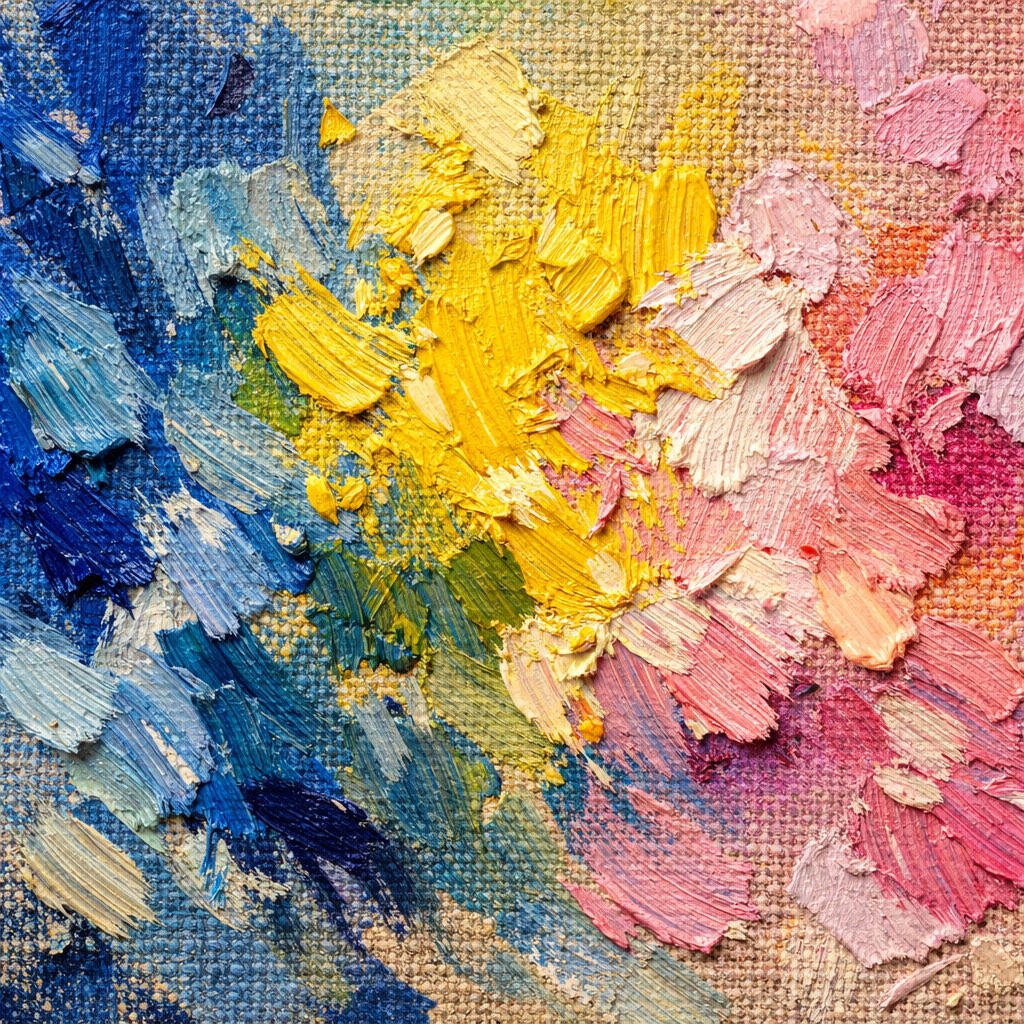
Instead of mixing pigments on the palette to create a smooth, blended tone, Impressionists placed small, distinct strokes of pure color side by side on the canvas.
The viewer's eye blends these dabs at a distance — a technique called optical mixing. This produced colors that appeared more luminous and vibrant than traditional pre-mixed pigments.
Example: Rather than darkening a shadow with black, an artist might set strokes of blue and violet beside warm orange highlights, so each color looks more intense to the eye.
Plein Air Painting
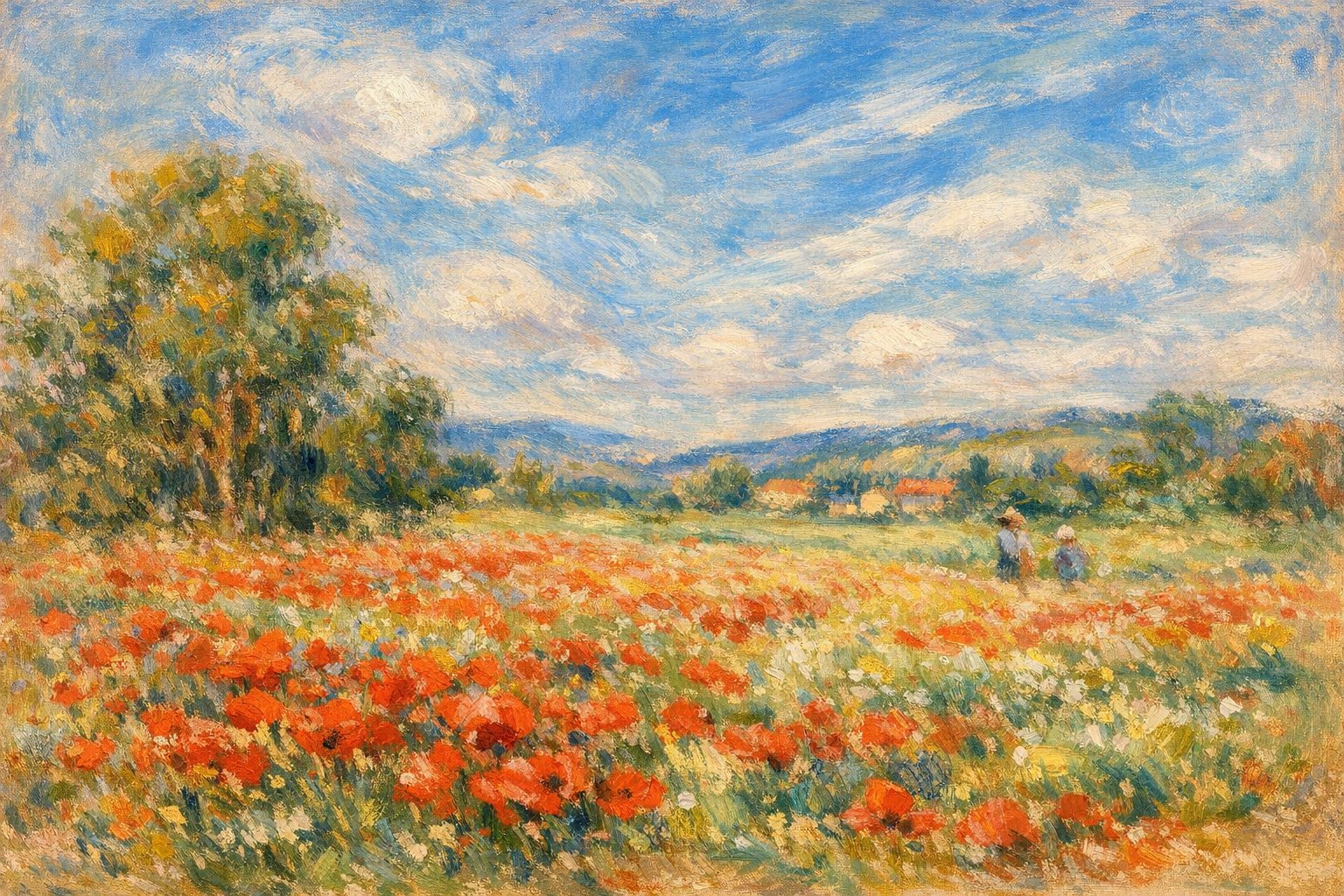
Impressionists moved out of the studio and painted en plein air (outdoors) to capture natural light directly.
This was made possible by:
Working outdoors forced rapid execution — light changed constantly, so painters developed their signature loose, spontaneous brushwork out of practical necessity.
This was made possible by:
- Portable easels and folding stools
- Collapsible tin paint tubes (invented 1841 by John Goffe Rand)
- New pre-mixed paints in brilliant synthetic pigments
- Expanding railway networks for easy travel to countryside
Working outdoors forced rapid execution — light changed constantly, so painters developed their signature loose, spontaneous brushwork out of practical necessity.
Light & Atmosphere
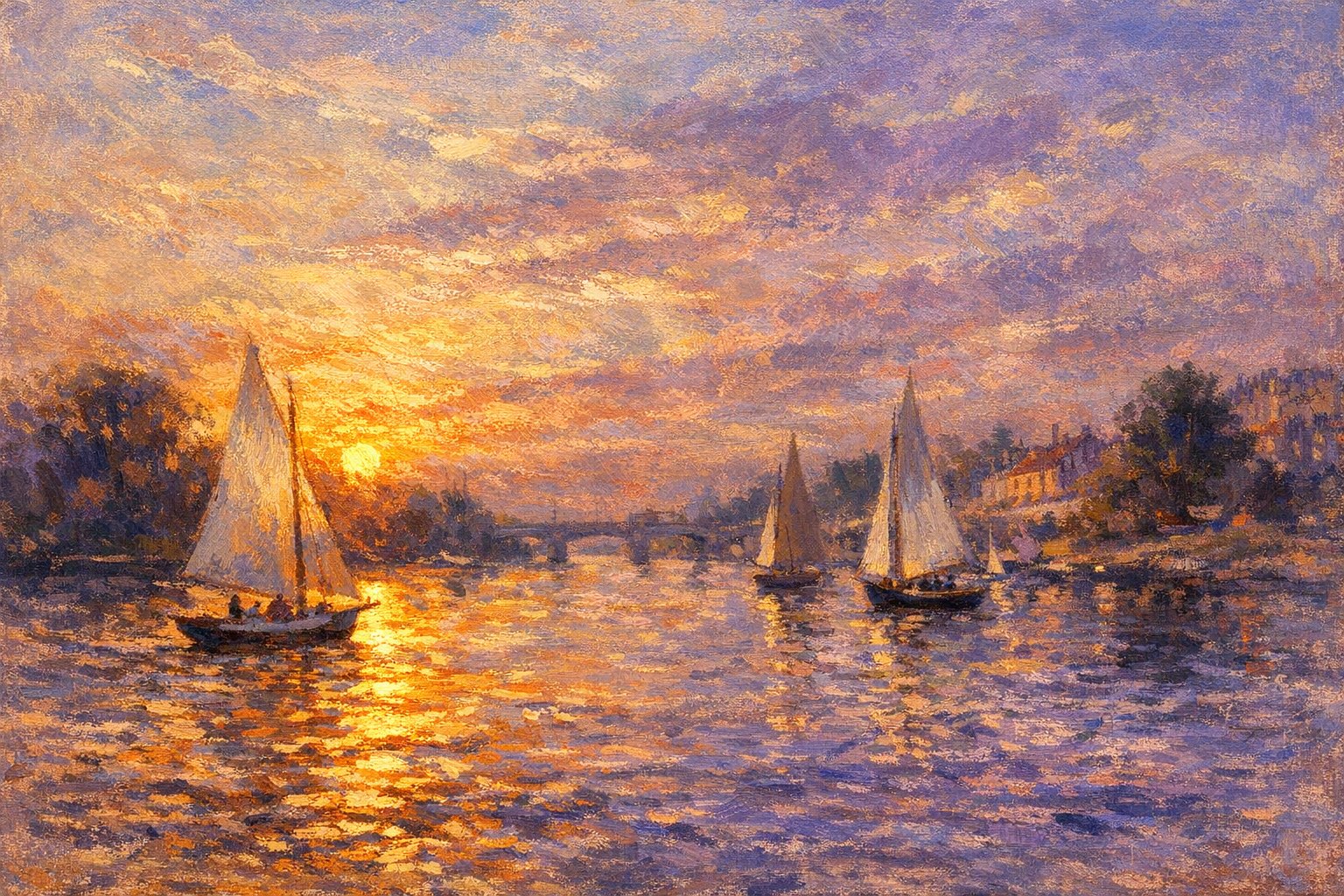
Capturing transient effects of light was the movement's central obsession.
"I am following Nature without being able to grasp her… I want to succeed in conveying what I feel." — Claude Monet
- Shadows rendered in color (blues, purples, greens) rather than black or brown
- Highlights captured with pure white or pale tints applied thickly
- Time of day, weather, and season were primary subjects
- Monet's famous series paintings (Haystacks, Rouen Cathedral, Water Lilies) documented the same subject under dozens of different lighting conditions
"I am following Nature without being able to grasp her… I want to succeed in conveying what I feel." — Claude Monet
Modern Composition
Impressionists broke from classical compositional rules:
- Asymmetric framing — subjects cropped at edges, inspired by photography and Japanese prints
- High & unusual viewpoints — Degas painted dancers from above; Caillebotte used dramatic perspective
- Everyday subjects — picnics, cafés, train stations, laundry, boating, city streets
- Figures in motion — capturing a moment mid-action rather than posed stillness
- Flattened depth — reduced modeling and shading, emphasizing surface pattern over illusionistic space
Chevreul's Color Theory
Michel Eugène Chevreul's 1839 treatise On the Law of Simultaneous Contrast of Colors proved that adjacent colors influence each other's appearance. Impressionists applied this science intuitively — placing complementary colors (orange/blue, red/green) side by side to intensify vibrancy.
Michel Eugène Chevreul's 1839 treatise On the Law of Simultaneous Contrast of Colors proved that adjacent colors influence each other's appearance. Impressionists applied this science intuitively — placing complementary colors (orange/blue, red/green) side by side to intensify vibrancy.
Key Artists — Biographical Profiles
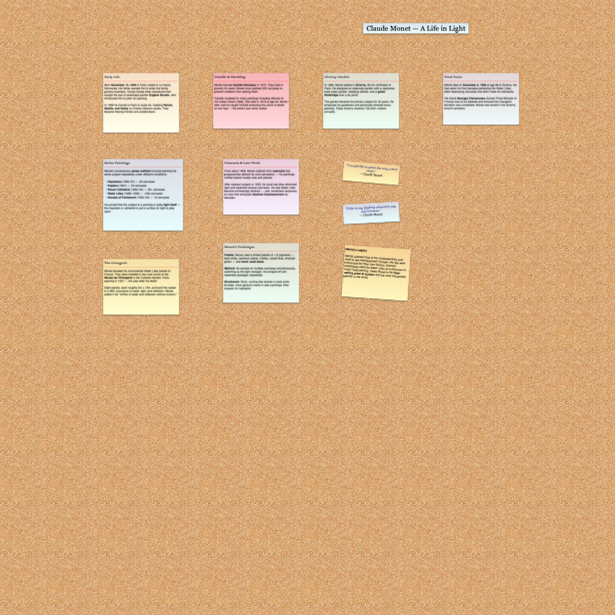
Claude Monet
1840–1926 | Paris & Giverny, France
The quintessential Impressionist and the movement's most dedicated practitioner. Monet pursued the study of light with almost scientific rigor.
Key works:
Legacy: Monet's late Water Lilies, with their near-abstract dissolution of form, anticipated Abstract Expressionism by decades. He painted until near-blindness, never abandoning his quest to capture light.
The quintessential Impressionist and the movement's most dedicated practitioner. Monet pursued the study of light with almost scientific rigor.
Key works:
- Impression, Sunrise (1872) — the painting that named the movement
- Water Lilies series (1896–1926) — ~250 oil paintings of his Giverny garden
- Haystacks series (1890–91) — same subject in varying light
- Rouen Cathedral series (1892–94)
Legacy: Monet's late Water Lilies, with their near-abstract dissolution of form, anticipated Abstract Expressionism by decades. He painted until near-blindness, never abandoning his quest to capture light.
Pierre-Auguste Renoir
1841–1919 | Limoges & Paris, France
Renoir brought warmth, joy, and sensuality to Impressionism, focusing on the human figure and scenes of leisure.
Key works:
Style: Rich, warm palette; soft, feathery brushwork; glowing skin tones achieved by layering thin glazes. In the 1880s, he underwent a "dry period" influenced by Raphael, then returned to a looser, more colorful late style.
Legacy: Renoir's celebration of beauty and pleasure made him one of the most popular painters in history. He painted through severe rheumatoid arthritis in his final years, with brushes strapped to his hands.
Renoir brought warmth, joy, and sensuality to Impressionism, focusing on the human figure and scenes of leisure.
Key works:
- Bal du moulin de la Galette (1876) — dappled sunlight on dancing crowds
- Luncheon of the Boating Party (1881)
- The Swing (1876)
Style: Rich, warm palette; soft, feathery brushwork; glowing skin tones achieved by layering thin glazes. In the 1880s, he underwent a "dry period" influenced by Raphael, then returned to a looser, more colorful late style.
Legacy: Renoir's celebration of beauty and pleasure made him one of the most popular painters in history. He painted through severe rheumatoid arthritis in his final years, with brushes strapped to his hands.
Édouard Manet
1832–1883 | Paris, France
Manet never exhibited with the Impressionists, yet he was their greatest catalyst. His bold modernism shattered academic conventions.
Key works:
Style: Flat, unmodulated areas of color; stark tonal contrasts; visible brushwork; modern Parisian subjects treated with classical scale and ambition.
Legacy: Manet is the bridge between Realism and Impressionism. His willingness to shock the establishment gave younger artists permission to break every rule.
Manet never exhibited with the Impressionists, yet he was their greatest catalyst. His bold modernism shattered academic conventions.
Key works:
- Le Déjeuner sur l'herbe (1863)
- Olympia (1863) — confrontational modern nude
- A Bar at the Folies-Bergère (1882)
Style: Flat, unmodulated areas of color; stark tonal contrasts; visible brushwork; modern Parisian subjects treated with classical scale and ambition.
Legacy: Manet is the bridge between Realism and Impressionism. His willingness to shock the establishment gave younger artists permission to break every rule.
Landmark Works
Impression, Sunrise
Claude Monet, 1872
Oil on canvas, 48 × 63 cm
Musée Marmottan Monet, Paris
A hazy view of Le Havre harbor at dawn — small boats, industrial cranes, and a vivid orange sun reflected on blue-grey water. The painting's loose, sketch-like quality outraged critics but perfectly embodied the Impressionist ideal: capturing a fleeting moment of light and atmosphere rather than a polished, detailed scene.
This single painting gave the entire movement its name.
Bal du moulin…
Pierre-Auguste Renoir, 1876
Oil on canvas, 131 × 175 cm
Musée d'Orsay, Paris
Bal du moulin de la Galette captures an outdoor dance in Montmartre with dappled sunlight filtering through acacia trees onto laughing, chatting Parisians. Renoir used friends as models.
The painting is a masterclass in rendering light on moving figures — warm golden patches on skin, cool blue-violet shadows on clothing. It celebrates the joy of modern urban life and remains one of the most reproduced Impressionist works.
The Dance Class
Edgar Degas, 1874
Oil on canvas, 85 × 75 cm
Musée d'Orsay, Paris
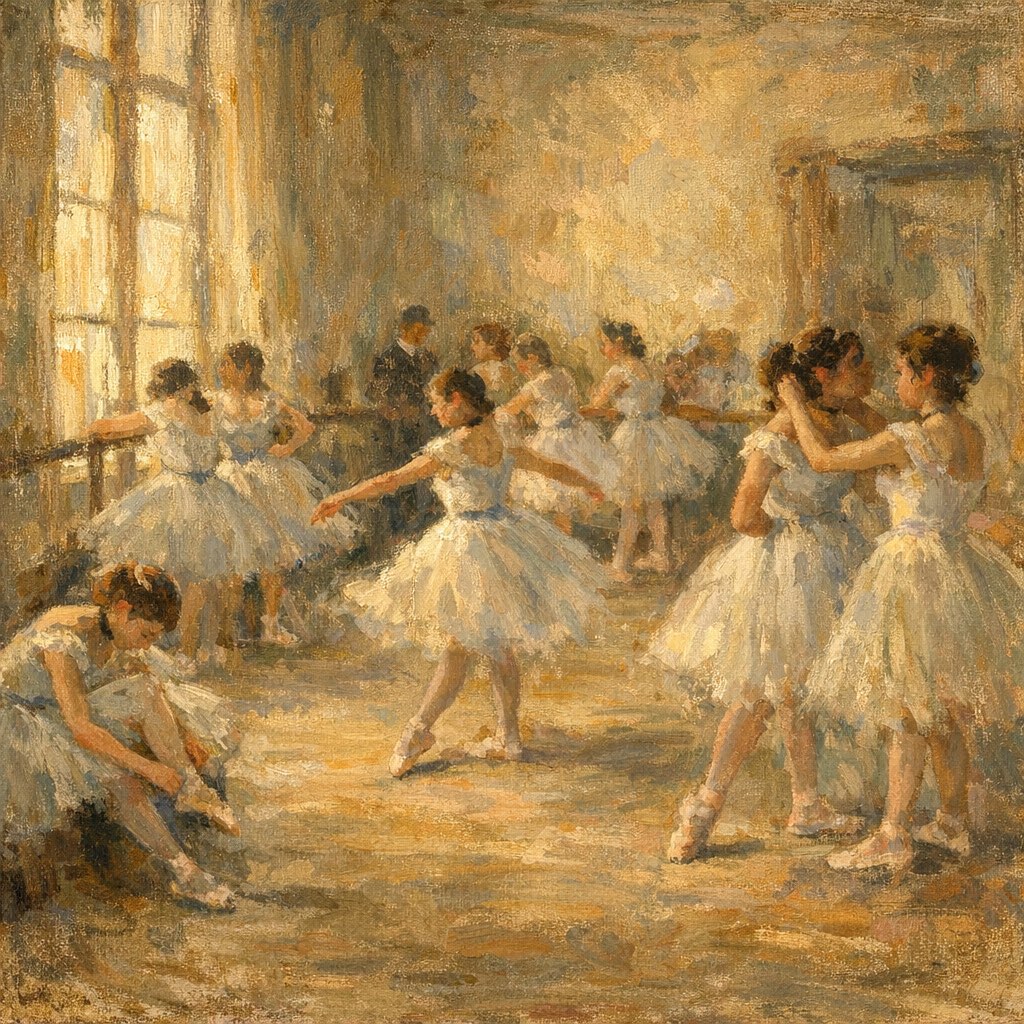
Young ballerinas practice under the watchful eye of ballet master Jules Perrot in a rehearsal room flooded with natural light. Degas's elevated viewpoint and off-center composition create a sense of spontaneous observation.
The painting demonstrates Degas's unique position: Impressionist in color and light, yet classical in his emphasis on drawing, structure, and the human figure. His obsession with dancers produced over 1,500 works on the subject.
Water Lilies Series
Claude Monet, 1896–1926
Approximately 250 oil paintings
Musée de l'Orangerie, MoMA, National Gallery, etc.
Monet spent his last thirty years painting the water garden at his home in Giverny. The series progresses from recognizable pond scenes to vast, nearly abstract fields of color — dissolving the boundary between water, sky, and reflection.
The monumental panels installed in the Orangerie (each about 2 m high) immerse the viewer in an enveloping panorama of light and color. They are now seen as a prophetic link to Abstract Expressionism and Color Field painting.
Manet's Olympia (1863)
A reclining nude gazes directly at the viewer with bold confidence. Unlike idealized classical nudes, Olympia was clearly a contemporary Parisian woman — likely a courtesan. The flat lighting, stark outlines, and confrontational gaze scandalized the 1865 Salon. It declared that modern art could address modern life without apology.
A reclining nude gazes directly at the viewer with bold confidence. Unlike idealized classical nudes, Olympia was clearly a contemporary Parisian woman — likely a courtesan. The flat lighting, stark outlines, and confrontational gaze scandalized the 1865 Salon. It declared that modern art could address modern life without apology.
Influences & Relationships
Precursors
Several earlier artists paved the way:
- J.M.W. Turner (1775–1851) — dissolved form in luminous atmospheric effects; Monet admired his work in London
- John Constable (1776–1837) — painted outdoors, studied clouds and weather scientifically
- Eugène Delacroix (1798–1863) — expressive color over line; complementary color shadows
- Gustave Courbet (1819–1877) — Realism's insistence on everyday subjects and direct observation
- Camille Corot (1796–1875) — plein air sketches with silvery light; mentored Pissarro and Morisot
- Eugène Boudin (1824–1898) — beach scenes; directly taught the young Monet to paint outdoors
Japonisme
The opening of Japan to Western trade in the 1850s flooded Paris with ukiyo-e woodblock prints by Hokusai, Hiroshige, and Utamaro.
Impact on Impressionism:
Monet collected over 200 Japanese prints; Degas and Cassatt were deeply influenced by their compositional daring. Cassatt's color prints directly emulate the ukiyo-e aesthetic.
Impact on Impressionism:
- Flat areas of color without traditional Western shading
- Asymmetric, cropped compositions — figures cut by the frame edge
- Bold outlines and decorative patterns
- Elevated and unusual viewpoints
- Everyday subjects (landscapes, seasons, leisure)
Monet collected over 200 Japanese prints; Degas and Cassatt were deeply influenced by their compositional daring. Cassatt's color prints directly emulate the ukiyo-e aesthetic.
Photography's Impact
The invention of photography (1839) profoundly shaped Impressionism:
Paradoxically, photography both challenged painting's purpose and liberated it to explore subjective perception — what the eye and mind feel, not just what the lens records.
- Freed painters from documentation — no need to record reality exactly when cameras could do it
- Snapshot aesthetics — blurred motion, accidental cropping, candid moments
- New ways of seeing — aerial views, close-ups, unusual angles
- Eadweard Muybridge's motion studies (1878) influenced Degas's depictions of horses and dancers
Paradoxically, photography both challenged painting's purpose and liberated it to explore subjective perception — what the eye and mind feel, not just what the lens records.
Key Relationships
- Monet & Renoir painted side by side at La Grenouillère (1869) — their canvases of the same scene show how each interpreted light differently
- Degas & Cassatt — he invited her to exhibit; she called it the turning point of her life
- Pissarro & Cézanne — Pissarro mentored Cézanne, who called him "humble and colossal"
- Manet & Morisot — she married his brother; they influenced each other's brushwork
- Bazille hosted struggling friends in his studio before his death in the Franco-Prussian War (1870)
Paul Durand-Ruel — The Dealer Who Saved Impressionism
Art dealer Paul Durand-Ruel took an enormous financial risk by buying Impressionist works when no one else would. He purchased hundreds of paintings from Monet, Renoir, Pissarro, Sisley, and Degas — often keeping them afloat financially.
His 1886 exhibition in New York introduced Impressionism to America and finally made the movement commercially viable. Without Durand-Ruel, several Impressionists might have abandoned painting entirely.
Lasting Impact & Legacy
Post-Impressionism
By the mid-1880s, artists began pushing beyond Impressionism while building on its foundations:
- Paul Cézanne — structured color planes; "treat nature by the cylinder, the sphere, the cone" → led to Cubism
- Georges Seurat — systematized broken color into Pointillism (tiny dots of pure color)
- Paul Gauguin — bold flat color, symbolism, and non-Western subjects → influenced Fauvism
- Vincent van Gogh — expressive, emotional brushwork and vivid color → influenced Expressionism
- Henri de Toulouse-Lautrec — graphic, poster-like compositions of Parisian nightlife
Into the 20th Century
Impressionism's radical innovations rippled through every subsequent art movement:
The Impressionists proved that subjective perception was as valid a subject for art as any historical narrative.
- Fauvism (1905) — Matisse and Derain pushed Impressionist color to wild, non-naturalistic extremes
- Cubism (1907) — Picasso and Braque built on Cézanne's geometric simplification
- Abstract Expressionism (1940s) — Monet's late Water Lilies anticipated the all-over, immersive canvases of Pollock and Rothko
- Color Field Painting — pure color experience echoes Impressionist optical mixing
- Plein air tradition continues worldwide today
The Impressionists proved that subjective perception was as valid a subject for art as any historical narrative.
Cultural Popularity
Impressionism is the most popular art movement in history by virtually every measure:
What was once ridiculed as unfinished has become the world's most beloved art.
- Museum attendance — Impressionist galleries at the Musée d'Orsay, National Gallery, and Art Institute of Chicago are consistently the most visited rooms
- Auction records — Monet's Meules sold for $110.7 million in 2019; Cézanne's The Card Players sold privately for ~$250 million
- Reproductions — Impressionist images dominate calendars, posters, and merchandise worldwide
- Tourism — Giverny (Monet's garden) receives 700,000+ visitors annually
What was once ridiculed as unfinished has become the world's most beloved art.
Why Impressionism Matters
Before Impressionism, art was judged by how closely it matched an idealized reality. After Impressionism, art was free to explore how we see, how we feel, and what we choose to notice.
The Impressionists didn't just change painting — they changed the very definition of what art could be. Every movement that followed — from Cubism to Abstract Expressionism to contemporary installation art — owes a debt to those rebellious painters who dared to trust their own eyes.
Timeline of Key Events
Deep Dives
Claude Monet — Life & Works
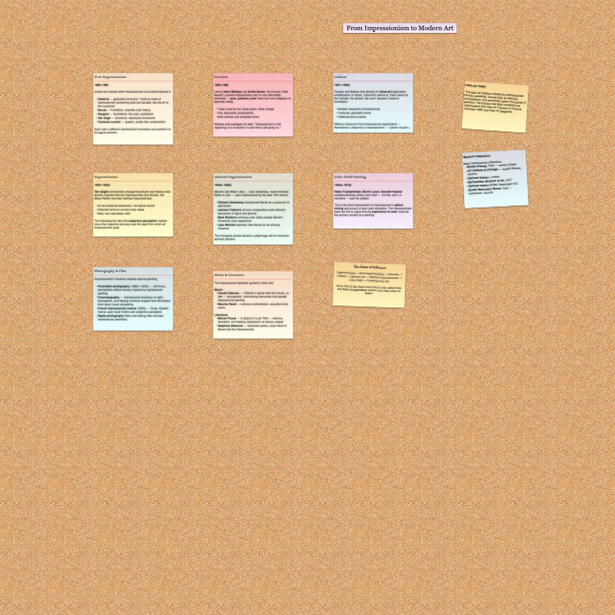
From Impressionism to Modern Art
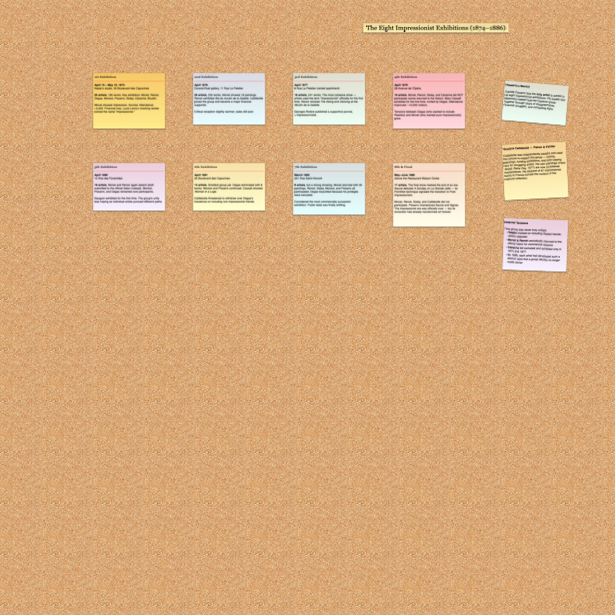
The Eight Impressionist Exhibitions
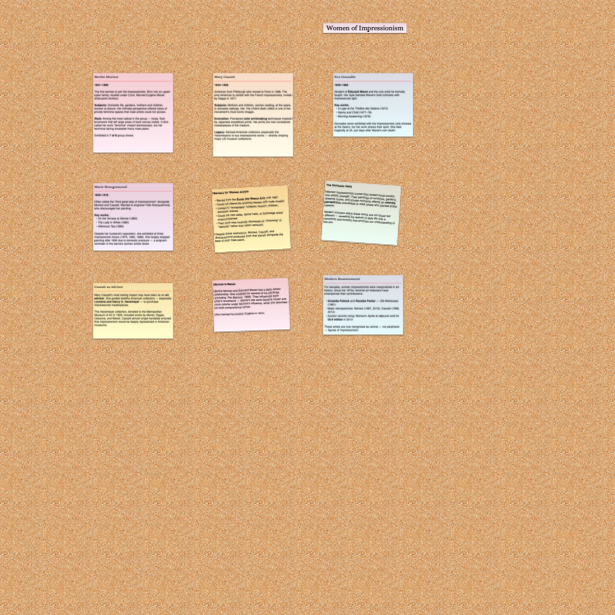
Women of Impressionism

The Impressionist Art Market
"Everyone discusses my art and pretends to understand, as if it were necessary to understand, when it is simply necessary to love."
— Claude Monet
— Claude Monet
"Why shouldn't art be pretty? There are enough unpleasant things in the world."
— Pierre-Auguste Renoir
— Pierre-Auguste Renoir
"Art is not what you see, but what you make others see."
— Edgar Degas
— Edgar Degas
"Painting from nature is not copying the object; it is realizing one's sensations."
— Paul Cézanne
— Paul Cézanne
Mary Cassatt
1844–1926 | Pittsburgh, USA → Paris, France
The only American to exhibit with the French Impressionists. Cassatt was invited by Degas, who admired her draftsmanship.
Key works:
Style: Intimate scenes of mothers and children; strong drawing influenced by Degas and Japanese prints; innovative use of color printmaking techniques.
Legacy: Cassatt was instrumental in promoting Impressionism in America, advising wealthy collectors like the Havemeyers to purchase works that now form the core of major US museum collections.
The only American to exhibit with the French Impressionists. Cassatt was invited by Degas, who admired her draftsmanship.
Key works:
- The Child's Bath (1893)
- Little Girl in a Blue Armchair (1878)
- The Boating Party (1893–94)
Style: Intimate scenes of mothers and children; strong drawing influenced by Degas and Japanese prints; innovative use of color printmaking techniques.
Legacy: Cassatt was instrumental in promoting Impressionism in America, advising wealthy collectors like the Havemeyers to purchase works that now form the core of major US museum collections.
Alfred Sisley
1839–1899 | Paris, France (British parents)
The most purely landscape-focused Impressionist. Sisley devoted his career almost exclusively to painting the skies, rivers, and villages of the Île-de-France.
Key works:
Style: Subtle, atmospheric palette; delicate rendering of clouds and water; quiet, contemplative compositions. His work is often compared to Constable and Corot.
Legacy: Underappreciated in his lifetime (he died in poverty), Sisley is now recognized as one of the finest landscape painters of the 19th century.
The most purely landscape-focused Impressionist. Sisley devoted his career almost exclusively to painting the skies, rivers, and villages of the Île-de-France.
Key works:
- Flood at Port-Marly (1876)
- Snow at Louveciennes (1878)
- Bridge at Moret-sur-Loing (1893)
Style: Subtle, atmospheric palette; delicate rendering of clouds and water; quiet, contemplative compositions. His work is often compared to Constable and Corot.
Legacy: Underappreciated in his lifetime (he died in poverty), Sisley is now recognized as one of the finest landscape painters of the 19th century.
Camille Pissarro
1830–1903 | St. Thomas & Paris, France
The eldest and most steadfast Impressionist — the only artist to exhibit in all eight group exhibitions (1874–1886). Known as the "dean of Impressionism."
Key works:
Style: Earthy, rural palette; structured compositions of peasant life and landscapes; later experimented with Neo-Impressionist pointillism before returning to Impressionism.
Legacy: Pissarro was a generous mentor to younger artists including Cézanne and Gauguin, and he later took up Seurat's pointillism himself. His open-mindedness and collaborative spirit held the fractious group together.
The eldest and most steadfast Impressionist — the only artist to exhibit in all eight group exhibitions (1874–1886). Known as the "dean of Impressionism."
Key works:
- Boulevard Montmartre series (1897)
- The Harvest at Montfoucault (1876)
- Red Roofs (1877)
Style: Earthy, rural palette; structured compositions of peasant life and landscapes; later experimented with Neo-Impressionist pointillism before returning to Impressionism.
Legacy: Pissarro was a generous mentor to younger artists including Cézanne and Gauguin, and he later took up Seurat's pointillism himself. His open-mindedness and collaborative spirit held the fractious group together.
Berthe Morisot
1841–1895 | Bourges & Paris, France
The first woman to join the Impressionists, Morisot exhibited in seven of the eight group shows — more than Monet, Renoir, or Sisley.
Key works:
Style: Delicate, fluid brushwork; luminous pastel palette; intimate domestic scenes — gardens, interiors, mothers with children. Her loose, sketch-like technique was among the most radical in the group.
Legacy: Morisot proved women could be at the forefront of avant-garde art. Married to Édouard Manet's brother Eugène, she was central to the movement's social and artistic network.
The first woman to join the Impressionists, Morisot exhibited in seven of the eight group shows — more than Monet, Renoir, or Sisley.
Key works:
- The Cradle (1872) — tender maternal scene
- Summer's Day (1879) — women boating on a lake
- In the Dining Room (1886)
Style: Delicate, fluid brushwork; luminous pastel palette; intimate domestic scenes — gardens, interiors, mothers with children. Her loose, sketch-like technique was among the most radical in the group.
Legacy: Morisot proved women could be at the forefront of avant-garde art. Married to Édouard Manet's brother Eugène, she was central to the movement's social and artistic network.
Edgar Degas
1834–1917 | Paris, France
Degas combined Impressionist color and light with a draftsman's precision. He preferred indoor subjects and rarely painted landscapes.
Key works:
Style: Unusual viewpoints (from above, from wings of stage), cropped compositions influenced by photography, masterful use of pastel medium. He also created wax sculptures.
Legacy: Degas bridged classical draftsmanship and modern vision. His compositional innovations influenced photography, cinema, and graphic design.
Degas combined Impressionist color and light with a draftsman's precision. He preferred indoor subjects and rarely painted landscapes.
Key works:
- The Dance Class (1874)
- L'Absinthe (1876) — alienation in modern Paris
- The Tub (1886) — intimate pastel of a bather
- Over 1,500 depictions of dancers
Style: Unusual viewpoints (from above, from wings of stage), cropped compositions influenced by photography, masterful use of pastel medium. He also created wax sculptures.
Legacy: Degas bridged classical draftsmanship and modern vision. His compositional innovations influenced photography, cinema, and graphic design.
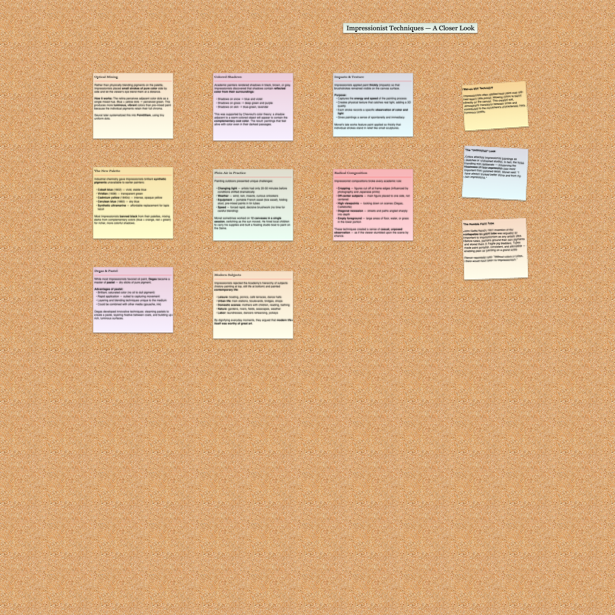
Impressionist Techniques — In Depth
0:00
0:00
Impressionism — The Movement That Changed Art Forever
Audio
Defining Techniques & Innovations